Patient Experience
What to Expect at Your Cataract Consultation
Dr. Nikitha Reddy, MD
March 18, 2026

Medically reviewed by Dr. Ruhi Soni, MD
Board-Certified Ophthalmologist • Soni Vision Institute
If you have been told you may have cataracts, or you have noticed changes in your vision and want answers, your first cataract consultation is an important step. It is also completely normal to feel a little nervous beforehand, especially if you have never had a detailed eye evaluation. The good news is that the process is straightforward, painless, and designed to give you and your surgeon a clear picture of your eye health and your options.
Here is a step-by-step look at what happens during a cataract consultation at Soni Vision Institute, so you know exactly what to expect.
Before Your Visit
A little preparation goes a long way toward making your appointment smooth and efficient. Here is what to bring and keep in mind:
- Your insurance card — Our team will verify your coverage and walk you through any out-of-pocket costs.
- A list of your current medications — Include prescription medications, over-the-counter supplements, and eye drops. Certain medications can affect your eyes and surgical planning, so a complete list is helpful.
- Your current glasses or contact lens prescription — If you have it available, bring it along. If not, we will measure your prescription during the visit.
- Sunglasses — Your pupils will be dilated during the exam, which makes your eyes sensitive to light for a few hours afterward. A pair of sunglasses will make the drive home more comfortable.
- A driver (recommended) — While many patients are comfortable driving after dilation, having someone available to drive you home is a good idea, especially for your first visit.
Plan for the visit to take approximately a few hours. This allows time for all the necessary testing, your examination, and a thorough conversation with your surgeon without feeling rushed.
The Eye Exam
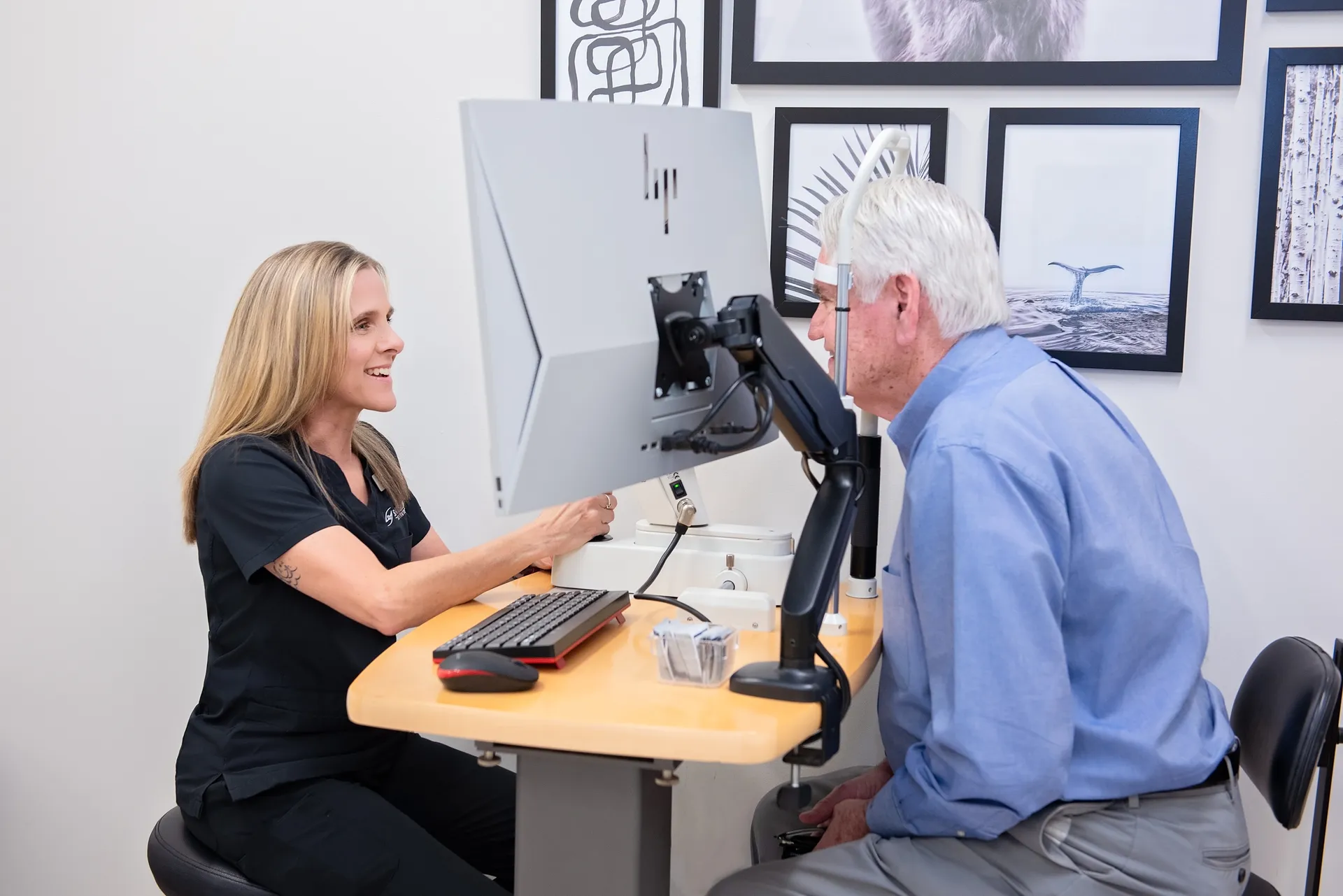
Your consultation begins with a comprehensive eye examination. Our team will perform several tests to evaluate the overall health of your eyes and the extent of any cataract changes:
Visual Acuity Testing
This is the familiar eye chart test. You will read letters at various sizes to measure how sharp your vision is at distance and near, with and without your current glasses. This establishes a baseline and helps your surgeon understand how much the cataract is affecting your functional vision.
Refraction
Your technician will determine your current glasses prescription by having you look through a series of lenses. This helps distinguish whether your vision changes are due to a simple prescription shift or to cataract development.
Slit Lamp Examination
Using a specialized microscope called a slit lamp, your doctor will examine the front structures of your eye in detail, including the cornea, iris, and the natural lens. This is where the cataract itself is directly visualized and its type and severity are assessed.
Dilated Eye Exam
Eye drops are used to widen your pupils, giving your doctor a full view of the lens, retina, and optic nerve. Dilation is essential for evaluating the cataract completely and for checking the health of the back of the eye. The drops take about 20 to 30 minutes to take full effect, and your pupils may remain dilated for a few hours afterward.
Tonometry (Eye Pressure)
A quick, painless measurement of the pressure inside your eye. This is an important screening tool for glaucoma and is a standard part of every comprehensive eye evaluation.
Advanced Diagnostic Testing
Beyond the standard eye exam, a cataract consultation includes specialized imaging and measurements that are critical for surgical planning. These tests are painless, non-invasive, and take just a few minutes each.
Corneal Topography
This test maps the curvature and shape of your cornea, the clear front surface of your eye. The detailed map helps your surgeon identify any astigmatism and plan the most precise surgical approach. It also plays a role in determining which lens implant will give you the best visual outcome.
Biometry
Biometry uses advanced instruments to measure the exact length of your eye and the curvature of your cornea. These measurements are used to calculate the power of your lens implant so that your new lens is customized to your eye. Accuracy here directly affects your visual result after surgery.
OCT Scan (Optical Coherence Tomography)
An OCT scan creates a high-resolution cross-sectional image of your retina and optic nerve. This allows your surgeon to evaluate the health of the macula (the part of the retina responsible for sharp central vision) and rule out any conditions that could affect your surgical outcome. The scan takes just seconds and requires no contact with your eye.
Meeting Your Surgeon
After your testing is complete, you will sit down one-on-one with your surgeon. This is the most important part of the visit, and we encourage you to take your time and ask anything on your mind.
Your surgeon will review all of your test results with you and explain what they mean in plain terms. If a cataract is present, she will discuss how advanced it is, how much it is affecting your vision, and whether surgery is recommended now or whether monitoring is a better option for the time being.
If surgery is the right next step, your surgeon will walk you through the procedure itself, what to expect during recovery, and the risks and benefits. She will also answer every question you have. There is no pressure to make a decision on the spot. Our goal is for you to leave the consultation feeling informed, confident, and clear about your options.
Lens Selection
One of the most exciting parts of modern cataract surgery is the ability to choose a lens implant that fits your lifestyle and visual goals. During your consultation, your surgeon will introduce you to the lens options available and help you understand the differences.
There are several categories of lens implants, each designed to address different visual needs:
- Monofocal lenses — Designed for clear vision at one distance (typically far). Glasses are usually still needed for reading.
- Toric lenses — Correct astigmatism at the time of surgery, reducing dependence on glasses for distance.
- Extended Depth of Focus (EDOF) lenses — Provide a continuous range of vision from far to intermediate, with less dependence on glasses for everyday tasks.
- Multifocal lenses — Designed to provide clear vision at multiple distances, including near, intermediate, and far.
- Light Adjustable Lens (LAL) — The only lens that can be fine-tuned after surgery using light treatments, allowing your prescription to be customized once your eye has healed.
Your surgeon will recommend options based on your eye anatomy, your lifestyle, and your visual priorities. You can explore the full range of options on our advanced technology lenses page, or read our in-depth guide to advanced technology lens implants.
Tip: Write down your questions before your appointment. Common ones include: Will I still need glasses? What lens is best for my lifestyle? What does recovery look like? Having a list ensures you do not forget to ask something important.
After Your Consultation
If surgery is recommended and you are ready to move forward, our team will guide you through the next steps. There is nothing complicated for you to manage on your own.
- Scheduling surgery — Our surgical coordinator will work with you to find a date that fits your schedule. Cataract surgery is an outpatient procedure, so planning is straightforward.
- Insurance verification — Our team handles insurance authorization and will let you know about any costs before your surgery date.
- Pre-operative instructions — You will receive clear instructions about eye drops to start before surgery, medications to continue or pause, and what to expect on the day of surgery.
- Pre-operative measurements — In some cases, additional measurements may be taken at a separate visit to ensure your lens calculation is as precise as possible.
If you and your surgeon decide that monitoring is the right approach for now, you will be given a follow-up timeline so your cataract can be tracked over time. Either way, you will leave knowing exactly where things stand and what comes next.
The most important thing to know is that a cataract consultation is not a commitment to surgery. It is an opportunity to understand your vision, learn about your options, and make a decision on your own terms. If you have been noticing changes in your vision, scheduling an evaluation is the best first step.
Related resources: