

Multifocal Lens
See Clearly at Every Distance.
Multifocal intraocular lenses use advanced diffractive optics to deliver clear vision at multiple focal points — near, intermediate, and distance — so you can enjoy life without reaching for glasses.
Understanding Multifocal IOLs
What Is a Multifocal Lens?
A multifocal intraocular lens (IOL) is an advanced technology lens implant used during cataract surgery to replace the eye’s clouded natural lens. Unlike a standard monofocal lens that provides clear vision at only one distance, a multifocal IOL features concentric diffractive rings etched into its surface. These microscopic rings split incoming light into multiple focal points, allowing the brain to process images at near, intermediate, and far distances simultaneously. The result is a dramatically reduced dependence on glasses for most daily activities.
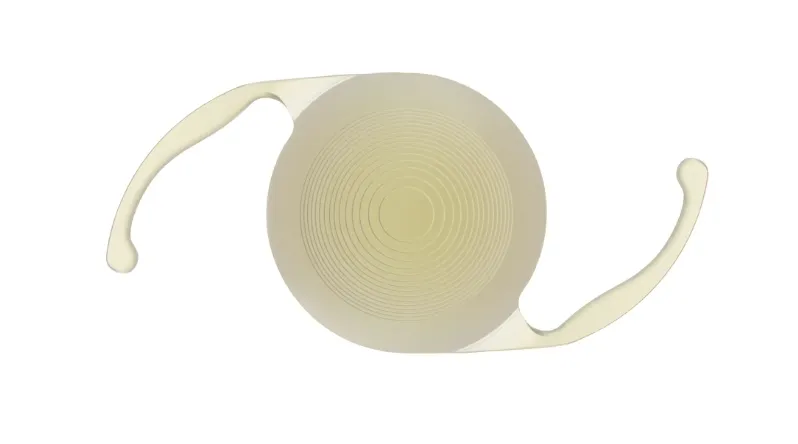
A multifocal IOL with concentric diffractive rings that split light into near, intermediate, and distance focal points.
At Soni Vision Institute, our highly trained surgeons use the latest-generation multifocal platforms, which offer improved light distribution and reduced optical disturbances compared to earlier designs. During your consultation, we perform precise biometric measurements of your eye and discuss your visual goals to determine whether a multifocal IOL is the best choice for your anatomy, lifestyle, and expectations. Every recommendation is individualized — because no two eyes are the same.
Why Patients Choose Multifocal
Key Benefits
Near + Intermediate + Distance Vision
See clearly at every range — from reading and phone use to driving — with a single lens implant.
High Rate of Glasses Independence
Over 80% of multifocal lens patients report complete freedom from glasses for everyday tasks after surgery.
Advanced Diffractive Optics
Latest-generation diffractive ring technology distributes light precisely for sharp focus at every focal point.
Permanent Correction
Once implanted, your multifocal IOL is designed to last a lifetime — no replacements, no maintenance, no expiration.
Your Journey
The Process
Lifestyle Assessment
We discuss your daily visual demands, hobbies, and goals to determine if a multifocal IOL aligns with your expectations.
Pre-Op Biometry
Advanced diagnostic imaging measures the exact dimensions and curvature of your eye to calculate the optimal lens power.
Multifocal Implantation
The procedure typically takes under 20 minutes. Your clouded lens is gently removed and replaced with a precision multifocal IOL.
Visual Adaptation
Over 4–8 weeks, your brain undergoes neuroadaptation, learning to seamlessly process light from multiple focal points for natural vision.
Common Questions
Multifocal Lens FAQ
Click any question to reveal the answer.
How Multifocal Lenses Work
How does a multifocal lens provide vision at multiple distances?
A multifocal IOL has concentric diffractive rings etched into its surface that split incoming light into multiple focal points — near, intermediate, and distance. Your brain learns to automatically select the correct focal point for each task through a process called neuroadaptation. The result is clear vision at virtually every range without glasses.
What is the difference between a multifocal lens and an EDOF lens?
A multifocal lens splits light into distinct near, intermediate, and distance focal points using diffractive rings — providing the strongest near vision but with a higher chance of halos and glare. An EDOF (Extended Depth of Focus) lens creates a continuous elongated focal range from distance through intermediate with fewer optical disturbances, but typically requires reading glasses for fine print. Your surgeon will help determine which design best matches your visual priorities.
What is neuroadaptation and how long does it take?
Neuroadaptation is the process by which your brain learns to interpret light from multiple focal points simultaneously. Distance vision typically sharpens first, with near and intermediate clarity continuing to improve over 4 to 8 weeks. Some patients notice continued refinement over several months. The process is natural and requires no effort on your part — your brain does the work automatically.
Halos, Glare & Vision Quality
Will I see halos or glare with a multifocal lens?
Some patients notice halos or glare around lights, especially at night, during the first several weeks after surgery. This is caused by the diffractive ring pattern and is expected. For the vast majority of patients, these effects diminish significantly over 4 to 8 weeks as neuroadaptation occurs. Fewer than 1% of patients find them bothersome enough to consider lens exchange.
Can I drive at night with a multifocal lens?
Yes. While you may notice halos around headlights and streetlights during the first few weeks, most patients adapt and drive comfortably at night. Latest-generation multifocal designs have improved light distribution that reduces nighttime visual disturbances compared to older multifocal lenses.
How well can I read with a multifocal lens?
Most multifocal lens patients can read books, menus, and their phone without glasses. Reading ability depends on the specific lens platform, lighting conditions, and how well your brain adapts. Some patients may still prefer reading glasses for very small print or prolonged reading in dim light.
Does a multifocal lens work well for computer and tablet use?
Yes. Multifocal lenses provide vision at intermediate distances (arm’s length), which is the typical range for computer and tablet use. Most patients work comfortably at a screen without glasses after multifocal lens implantation.
Candidacy
Am I a good candidate for a multifocal lens?
The best candidates are patients who strongly desire independence from glasses for most daily activities and have healthy corneas, a healthy macula, and manageable astigmatism. During your consultation, we evaluate your eye health, lifestyle, and visual goals to determine if a multifocal IOL is the best fit. A thorough pre-operative workup ensures we recommend the lens that gives you the best possible outcome.
Who should NOT get a multifocal lens?
Patients with macular degeneration, advanced glaucoma with significant visual field loss, corneal irregularities such as keratoconus, or those who are highly sensitive to visual disturbances may not be ideal candidates. Patients who perform extensive nighttime driving as a profession should also discuss their specific needs carefully with their surgeon before choosing a multifocal design.
Can a multifocal lens correct astigmatism?
Yes. Toric multifocal lenses combine multifocal technology with astigmatism correction in a single implant. If you have significant astigmatism, a toric multifocal IOL can address both your cataract and astigmatism while still providing near, intermediate, and distance vision — without the need for a separate astigmatism procedure.
Outcomes & Expectations
What is the satisfaction rate for multifocal lenses?
Patient satisfaction with modern multifocal IOLs is very high — studies consistently report satisfaction rates above 90%. The vast majority of patients say they would choose the same lens again. Satisfaction is highest when expectations are set clearly before surgery, which is why we spend significant time discussing what to expect during your consultation.
Will I ever need glasses after getting a multifocal lens?
Over 80% of multifocal lens patients report complete glasses independence for everyday tasks. However, some situations — such as reading very fine print in dim lighting or extended close-up work — may still benefit from low-power reading glasses. The goal is functional freedom from glasses for the vast majority of your daily activities, not absolute perfection in every scenario.
Can a multifocal lens be removed or exchanged if I don’t adapt?
In rare cases where a patient cannot adapt to the multifocal optics after a full neuroadaptation period, the lens can be exchanged for a different IOL type such as a monofocal or EDOF. This is an additional surgical procedure and is uncommon — fewer than 1% of patients request an exchange. A thorough pre-operative evaluation and honest conversation about expectations help minimize this possibility.
Does a multifocal lens affect contrast sensitivity?
Because a multifocal lens distributes light across multiple focal points, there can be a mild reduction in contrast sensitivity compared to a monofocal lens. In practice, most patients do not notice this difference in their daily lives. Latest-generation multifocal designs have made significant improvements in contrast performance while maintaining excellent range of vision.
How do I decide if a multifocal lens is right for my lifestyle?
The decision comes down to your priorities. If glasses-free vision for most activities is your top goal and you are comfortable with a short adaptation period, a multifocal lens is an excellent choice. If you prioritize the sharpest possible distance vision with minimal optical disturbances, a monofocal, EDOF, or Light Adjustable Lens (LAL) may be a better fit. Your surgeon will walk you through all options at your consultation to find the best match for how you use your eyes every day.
Content medically reviewed by the physicians of Soni Vision Institute. Last updated April 2026.
Take the Next Step
Ready to Take Your Vision to the Next Level?
Our highly trained surgeons will help you determine if a multifocal lens is the right choice for your vision and your life.