

Cataracts
Don’t Let Cloudy Vision Define Your Life.
Cataracts affect more than 24 million Americans — and they’re the leading cause of treatable vision loss worldwide. The good news? Modern cataract surgery is one of the safest, most effective procedures in medicine. Houston’s top-rated eye surgeons are right here in Cypress, TX.
The Basics
What Are Cataracts?
A cataract is a clouding of the eye’s natural crystalline lens — the transparent structure behind the iris that focuses light onto the retina. Over time, proteins within the lens begin to clump together and break down, forming opaque clusters that scatter incoming light instead of allowing it to pass through clearly.
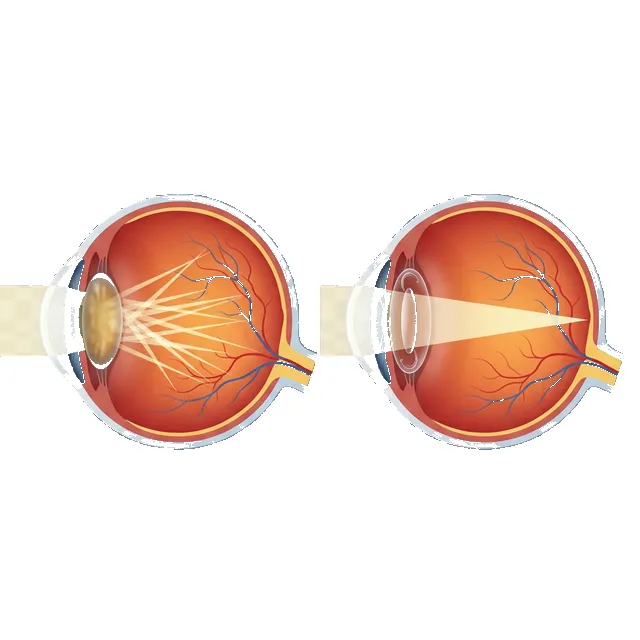
A clear lens focuses light sharply onto the retina. A cataract scatters light, causing blurry, hazy vision.
The result is a gradual, painless decline in vision quality. Colors may appear faded or yellowed. Fine details become harder to distinguish. Night driving grows increasingly difficult. Because the changes happen slowly — often over years — many people don’t realize how much vision they’ve lost until they are evaluated by an ophthalmologist.
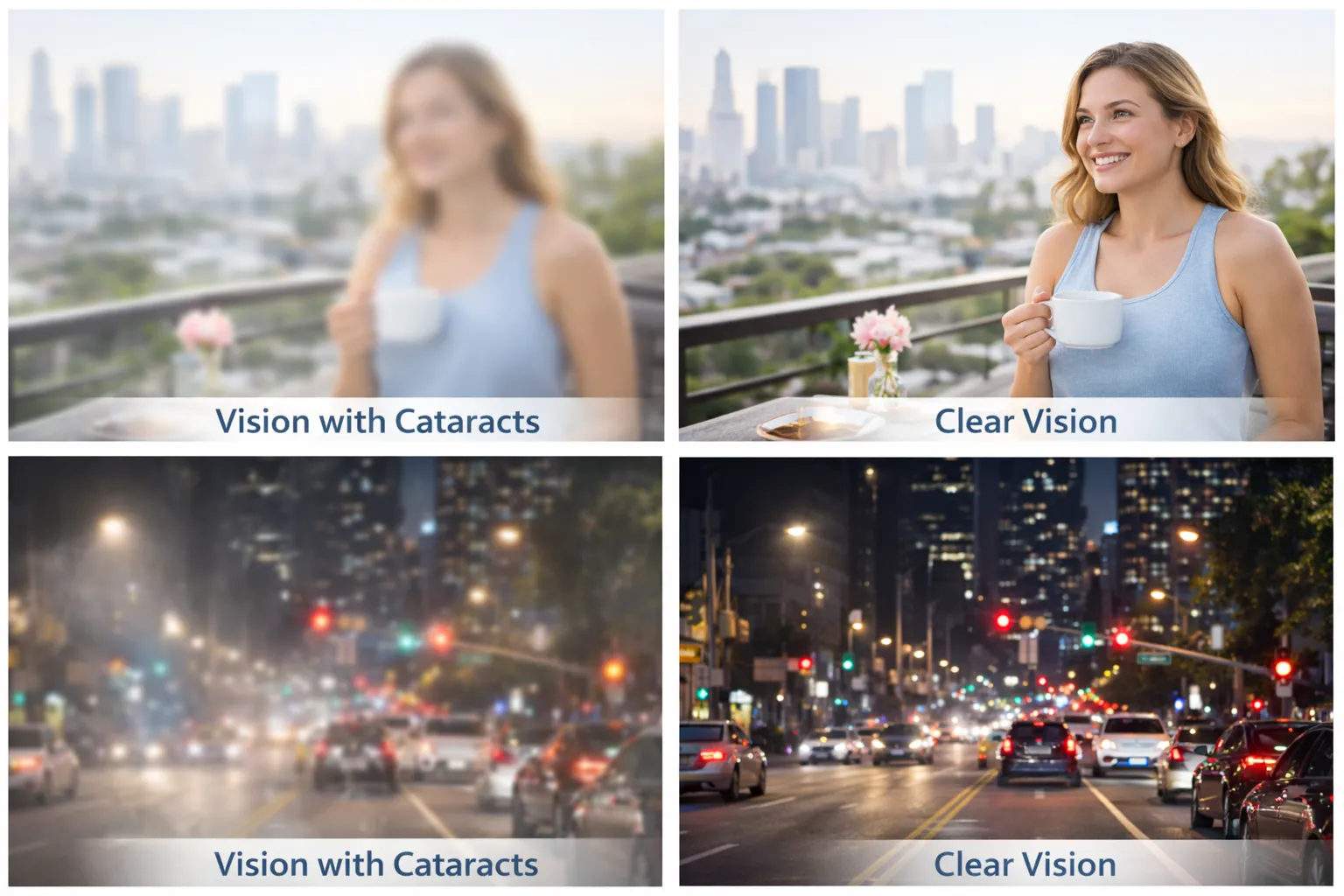
Cataracts cause blurry, hazy vision in both daylight and low-light conditions. Cataract surgery restores clear, sharp sight.
Cataracts are extremely common. By age 75, approximately 70% of Americans either have a cataract or have already undergone cataract surgery. While cataracts cannot be reversed with medication or eye drops, modern cataract surgery is one of the safest and most frequently performed procedures in medicine — with a success rate exceeding 98%.
At Soni Vision Institute, our board-certified surgeons Dr. Ruhi Soni and Dr. Nikitha Reddy specialize in advanced cataract surgery with advanced technology lens options. They work with patients across the greater Houston area to restore clear, vibrant vision.
Signs to Watch For
Common Cataract Symptoms
Blurry or Cloudy Vision
The most common early sign. Vision gradually becomes hazy, as if looking through a foggy or dirty window. Reading, recognizing faces, and seeing fine details become more difficult over time.
Glare & Halos
Increased sensitivity to bright lights, with halos or starbursts appearing around headlights, streetlamps, and other light sources. This is especially noticeable in low-light conditions.
Difficulty Driving at Night
Oncoming headlights may cause intense glare that makes it hard to see the road. Many cataract patients report feeling unsafe driving after dark — one of the most common reasons patients seek evaluation.
Faded Colors
As the lens yellows and darkens, colors lose their vibrancy. Whites may appear dingy or yellowish. Many patients are surprised by how vivid colors look after cataract surgery — describing it as “seeing in HD.”
Frequent Prescription Changes
Needing a new eyeglass or contact lens prescription more often than usual can be an early indicator. The shifting optical power of the clouding lens makes it difficult to maintain stable corrective lenses.
Double Vision in One Eye
A less common but notable symptom. The clouded lens can split light entering the eye, causing a ghost image or double vision (diplopia) that persists even when the other eye is closed.
Why Cataracts Develop
Causes & Risk Factors
Age
Age-related cataracts are by far the most common type. The natural proteins in the lens gradually break down and clump together starting around age 40. By the mid-60s, these changes often begin to affect day-to-day vision. Nearly everyone will develop some degree of cataract if they live long enough.
UV Exposure
Prolonged exposure to ultraviolet radiation from sunlight accelerates lens protein damage. Studies show that individuals with high cumulative UV exposure — particularly in sun-heavy climates like Texas — are at significantly higher risk. Wearing UV-blocking sunglasses and a brimmed hat can help slow cataract progression.
Medical Conditions
Diabetes is one of the strongest risk factors for early cataract development. High blood sugar causes biochemical changes in the lens that accelerate clouding. Long-term use of corticosteroid medications — whether oral, inhaled, or topical — is also associated with a specific type of cataract known as posterior subcapsular cataract.
Genetics & Lifestyle
Family history plays a role — if your parents or siblings developed cataracts early, you may be at higher risk. Smoking roughly doubles the risk of nuclear cataracts, and heavy alcohol consumption has been linked to increased cataract formation. Previous eye injury or surgery can also predispose the lens to early clouding.
Types
Types of Cataracts
Not all cataracts are the same. The type, location, and progression of your cataract influence how it affects your vision and when surgery is recommended.
Nuclear Sclerotic
The most common age-related type. Forms in the center (nucleus) of the lens and gradually causes it to harden and yellow. Patients often experience a temporary improvement in near vision — called “second sight” — before distance vision worsens significantly.
Cortical
Develops as white, wedge-shaped opacities in the outer edge (cortex) of the lens and slowly extends inward like spokes of a wheel. Causes problems with glare and contrast sensitivity — especially troublesome for night driving. More common in patients with diabetes.
Posterior Subcapsular
Forms on the back surface of the lens and tends to progress faster than other types. Particularly affects reading vision and causes significant glare in bright conditions. Associated with prolonged corticosteroid use, diabetes, and prior eye injury.
Take the Next Step
When to See a Doctor
You should schedule a comprehensive eye evaluation if you notice any of the following:
- Your vision is noticeably blurrier or hazier than it used to be, even with updated glasses
- You feel unsafe or uncomfortable driving at night due to glare
- Your eyeglass prescription keeps changing but vision doesn’t improve
- Colors appear faded, washed out, or have a yellowish tint
- Everyday activities like reading, cooking, or watching TV have become frustrating
The good news: you don’t have to wait until cataracts are “ripe” or severely advanced. Modern cataract surgery is safe, quick, and highly effective at any stage once your vision is impacting your quality of life. The procedure typically takes 10–15 minutes per eye, and most patients notice dramatically improved vision within 24–48 hours.
At Soni Vision Institute, we also offer advanced technology lens options — including Toric lenses for astigmatism, multifocal and Extended Depth of Focus (EDOF) lenses for spectacle independence, and the Light Adjustable Lens (LAL) that can be fine-tuned after surgery for truly customized vision. Your surgeon will help determine the best approach during your evaluation.
Why Choose Us
The Soni Vision Difference
When it comes to your vision, you deserve surgeons who specialize in what they do best. Soni Vision Institute is a primarily surgical practice — meaning cataract and lens-based surgery is not a sideline. It’s our focus, every single day.
Surgery-Focused Practice
Unlike general optometry offices that offer surgery as one of many services, cataract and refractive surgery is our core expertise. That focus translates to better outcomes.
Houston’s Top-Rated Eye Surgeons
Consistently rated among the top eye surgery practices in Houston, our patients rate their experience among the best in the Houston metro area.
Advanced Lens Technology
We offer every advanced technology lens available — including the Light Adjustable Lens (LAL), multifocal, Extended Depth of Focus (EDOF), and toric options — so your surgery can be tailored to your exact lifestyle and visual goals.
Boutique, Personalized Care
We are not a high-volume surgery mill. Every patient receives an unhurried, one-on-one consultation to determine the best surgical plan and lens choice for their unique eyes and lifestyle.

Patient Stories
What Our Cataract Patients Are Saying
Real reviews from patients who trusted Soni Vision Institute with their cataract surgery.
Cataract Surgery Patient
Cataract Surgery
Reviews
Top-rated. Hundreds of five-star reviews.
“Dr. Soni explained everything clearly, the surgery was quick and painless, and my vision is now better than it’s been in decades. The whole experience from start to finish was excellent.”
Robert K.
Dr. Soni · Cataract Surgery
“I cannot say enough about Dr. Reddy. She is very compassionate towards her patients. She explains everything pre surgery, during & post. I am very thankful for her restoring my eyesight back to 20/20. The entire staff at Soni Institute has been wonderful!”
Jeanine R.
Dr. Reddy · Cataract Surgery
“Dr. Soni actually sits in the exam room with you and patiently educates you on next steps and answers questions. We did not feel rushed or pressured in any way. If you are looking for a surgeon that really cares, this is the place for you!”
Karen O.
Dr. Soni · Cataract Surgery
“Dr. Reddy took so much time going over everything. I had many concerns about my eyes and she addressed them all. The staff was so friendly and kind. I am so happy to have found a very competent ophthalmologist.”
Wendy J.
Dr. Reddy · Cataract Surgery
“Starting at the front desk, I felt valued and cared for. The technicians were friendly, caring, and professional. Dr. Soni was extremely kind and thorough. At no point during my appointment did I feel rushed. Thank you all for your kindness.”
Darla S.
Dr. Soni · Cataract Surgery
“She’s an excellent doctor, very attentive to detail and she’s personable. She’s fantastic and great with the patient’s care. I would follow her anywhere. If you want someone who really takes care of you, she’s the perfect doctor.”
Rosa C.
Dr. Reddy · Cataract Surgery
“Dr. Soni truly takes her time with each patient and never makes you feel rushed. It’s rare to find a doctor who combines expertise with genuine care, and she does it effortlessly. Highly recommend her to anyone looking for an eye doctor who really listens.”
Melissa R.
Dr. Soni · Cataract Surgery
“Dr. Reddy is an excellent eye surgeon and can do it all. Soni Vision is lucky to have her in their practice. I would highly recommend her to anyone needing any kind of eye surgery. Thank you Dr. Reddy for being my surgeon.”
Mark S.
Dr. Reddy · Cataract Surgery
“The professionalism, expertise, and kindness was beyond my expectations. The staff was always welcoming and took the time to answer every question. I can see better now than I have in two decades.”
Maria R.
Dr. Soni · Cataract Surgery
“Dr. Reddy is an amazing surgeon and a wonderful, caring human being. Her attention to detail and genuine concern for my well-being made all the difference. I’m seeing clearly for the first time in years.”
James P.
Dr. Reddy · Cataract Surgery
“I am beyond grateful to Dr. Soni and the entire team. The results have been life-changing. My vision has improved dramatically, and I am now able to enjoy everyday activities with clarity I haven’t had in years.”
Treyce S.
Dr. Soni · Cataract Surgery
“She looked me in the eye and told me her job was to make my eyes outlast me. She restored my ocular pressure to normal without drops. I don’t even have to wear glasses anymore! I’d give 10 stars.”
Charley G.
Dr. Reddy · Cataract Surgery
Your Options
Treatment Options at Soni Vision Institute
Once cataracts begin interfering with daily life, surgery is the only proven treatment. Here are the approaches we offer.
Cataract Surgery
The gold standard: phacoemulsification removes the clouded lens through a micro-incision and replaces it with a clear intraocular lens implant. Outpatient, typically under 15 minutes.
Learn more →Laser Cataract Surgery
Femtosecond laser technology automates key steps of the procedure for enhanced precision. Especially beneficial for patients with astigmatism or those choosing advanced technology lenses.
Learn more →Advanced Technology Lenses
During cataract surgery, the clouded natural lens is replaced with an artificial intraocular lens (IOL). Advanced technology lens options can correct astigmatism, provide a full range of vision, and reduce or eliminate your need for glasses after surgery.
Not Ready for Cataracts? Consider Refractive Lens Exchange
If you’re over 45 and want to eliminate glasses but don’t yet have cataracts, refractive lens exchange uses the same advanced lens technology to replace your natural lens before cataracts ever develop — giving you the benefits of cataract surgery years earlier.
Learn about RLE →Common Questions
Cataracts FAQ
Understanding Cataracts
At what age do cataracts usually develop?
Most cataracts begin developing after age 40 as the proteins in the eye’s natural lens start to break down. However, they may not noticeably affect vision until the 60s or 70s. By age 75, approximately 70% of Americans have cataracts or have had cataract surgery. In some cases, cataracts can develop earlier due to injury, certain medications (such as corticosteroids), or medical conditions like diabetes.
Can cataracts come back after surgery?
No — once a cataract is removed, it cannot return. The clouded natural lens is permanently replaced with a clear artificial intraocular lens (IOL). However, some patients develop a condition called posterior capsule opacification (PCO), sometimes referred to as a “secondary cataract.” PCO occurs when the thin membrane behind the IOL becomes cloudy. It is easily and painlessly treated with a quick YAG laser procedure in the office, which takes only a few minutes.
How long does cataract surgery take?
The surgical procedure itself typically takes just 10 to 15 minutes per eye. You should plan to be at the surgical center for approximately a few hours total, which includes pre-operative preparation (eye drops, light sedation), the procedure, and a brief recovery period in the post-op area. Most patients are home resting comfortably within a few hours and notice improved vision within 24–48 hours.
Will I need glasses after cataract surgery?
It depends on the type of intraocular lens (IOL) you and your surgeon choose. With a standard monofocal lens, most patients achieve excellent distance vision but still need reading glasses for close-up tasks. With advanced technology lenses — such as multifocal, Extended Depth of Focus (EDOF), or the Light Adjustable Lens (LAL) — many patients achieve a full range of clear vision and significantly reduce or eliminate their dependence on glasses. Your surgeon will discuss the best option for your lifestyle during your cataract evaluation.
Prevention & Risk
What are the different types of cataracts?
The three main types are nuclear sclerotic (forms in the center of the lens, the most common age-related type), cortical (develops as wedge-shaped opacities in the outer lens), and posterior subcapsular (forms on the back surface of the lens, progresses faster, and is associated with steroid use and diabetes). Your ophthalmologist can determine which type you have during a comprehensive eye exam.
Does diabetes increase my risk of cataracts?
Yes. Diabetes is one of the strongest risk factors for early cataract development. High blood sugar causes biochemical changes in the lens that accelerate clouding. People with diabetes may develop cataracts 10 to 15 years earlier than average. Keeping your blood sugar well-controlled and seeing your ophthalmologist regularly can help monitor the progression.
Surgery & Lens Options
Is cataract surgery covered by insurance?
Yes — Medicare and most private insurance plans cover standard cataract surgery with a monofocal IOL when it is deemed medically necessary. Advanced technology lens upgrades (multifocal, toric, Extended Depth of Focus (EDOF), Light Adjustable Lens (LAL)) typically involve an out-of-pocket cost. Our team at Soni Vision Institute will verify your benefits and provide transparent pricing before your procedure.
What is the difference between standard and laser cataract surgery?
Standard cataract surgery (phacoemulsification) uses handheld instruments to create the incision and remove the cataract. Laser cataract surgery uses a femtosecond laser to automate several key steps — including the corneal incision, the capsulotomy, and softening of the lens — for enhanced precision. Laser-assisted surgery is especially beneficial for patients with astigmatism or those choosing advanced technology lenses. Learn more about laser cataract surgery →
What is a Light Adjustable Lens?
The Light Adjustable Lens (LAL) is the only intraocular lens that can be customized after cataract surgery using non-invasive light treatments in the office. This allows your surgeon to fine-tune your prescription once your eye has healed, delivering the most precise visual outcome possible. It is an excellent option for patients who want the absolute best vision without glasses. Learn more about the LAL →
How do I choose the right lens for cataract surgery?
Your surgeon will help you choose based on your lifestyle, visual priorities, and eye anatomy. If you want clear distance vision and don’t mind reading glasses, a monofocal lens may be ideal. If you want to reduce dependence on glasses at all distances, a multifocal, Extended Depth of Focus (EDOF), or Light Adjustable Lens (LAL) may be a better fit. If you have astigmatism, a toric lens can correct it at the same time. The decision is always personalized during your cataract evaluation.
Finding a Cataract Surgeon in Houston
Where is Soni Vision Institute located?
Soni Vision Institute is located at 27700 Northwest Freeway, Suite 390, Cypress, TX 77433 — right off Highway 290. We serve patients from Cypress, Katy, Tomball, Jersey Village, Copperfield, Spring, and the greater NW Houston area. Our office is easily accessible from the 290 corridor, Highway 6, and the Grand Parkway (99).
Do I need a referral for a cataract evaluation?
No referral is needed. You can book a cataract evaluation directly by calling our office at (346) 818-6780 or using our online booking form. If your optometrist has referred you, our team will coordinate all records and imaging before your visit.
What should I expect at my cataract consultation?
Your consultation will include a comprehensive eye exam, advanced imaging and measurements of your eye, a detailed discussion of your lens options, and a one-on-one conversation with your surgeon about what to expect from surgery and recovery. Most consultations take about 60 to 90 minutes. You will leave with a clear understanding of your options and a personalized surgical plan.
Explore More
Related Pages You May Find Helpful
Astigmatism
Learn how astigmatism is corrected during cataract surgery with toric lenses.
Learn more →Presbyopia
Age-related near vision loss often accompanies cataracts. Advanced lenses can address both.
Learn more →Glaucoma
Glaucoma and cataracts often coexist. MIGS can be performed alongside cataract surgery.
Learn more →Dry Eye
Dry eye can affect cataract surgery measurements. Treating it first ensures the best outcomes.
Learn more →Content medically reviewed by the physicians of Soni Vision Institute. Last updated April 2026.
Sources
- American Academy of Ophthalmology. "What Are Cataracts?" aao.org
- National Eye Institute. "Cataracts." nei.nih.gov
- World Health Organization. "Blindness and Vision Impairment." who.int
See the World Clearly Again.
Cataract surgery at Soni Vision Institute is quick, safe, and life-changing. Schedule your evaluation with Houston’s top-rated cataract surgeons in Cypress, TX.
Serving Cypress, Katy, Tomball, Jersey Village, Copperfield, and all of NW Houston along the 290 corridor.