

Light Adjustable Lens
The Only Lens Adjusted After Surgery.
The Light Adjustable Lens (LAL) by RxSight is the only intraocular lens that can be customized and optimized after implantation — using non-invasive light treatments that fine-tune your prescription once your eye has fully healed.
The Technology
What Is the Light Adjustable Lens?
Every other intraocular lens (IOL) is a fixed optic — once it is implanted, its prescription cannot be changed. The Light Adjustable Lens is fundamentally different. Made of a proprietary photosensitive silicone material, it can be reshaped after surgery by exposing it to precisely calibrated ultraviolet light treatments delivered in the clinic. This means your final prescription is not locked in on the operating table — it is determined after your eye has healed.
Once you and your surgeon are satisfied with your vision, a final lock-in treatment permanently sets the lens at its optimized power. No other IOL currently available offers this level of post-surgical control. The LAL is FDA-approved and is particularly well-suited for patients who have had prior corneal refractive surgery (LASIK, PRK), where IOL power calculation can be less predictable, and for anyone who demands the highest possible refractive accuracy from their cataract surgery.
Post-Surgery Fine-Tuning
Your prescription is customized after your eye has fully healed — eliminating the guesswork that affects all other IOL platforms.
Personalized to Your Healed Eye
Healing changes the eye. The LAL accounts for those changes — adjusting to the eye you actually have after recovery, not the eye we measured before surgery.
Highest Accuracy of Any IOL
Clinical studies demonstrate that LAL patients achieve target refraction more frequently than patients receiving any other IOL type — including other advanced technology lenses.
FDA-Approved Technology
The RxSight Light Adjustable Lens received FDA approval in 2017 and has since been implanted in hundreds of thousands of eyes worldwide with an exceptional safety record.
Surgical lens replacement can permanently correct presbyopia and eliminate the need for reading glasses.
Schedule a consultation to find out which option is right for you.
Your Journey
Your LAL Journey Step by Step
LAL Implantation
The Light Adjustable Lens is implanted during cataract surgery using the same outpatient technique as any other IOL. The procedure takes under 20 minutes. You begin wearing protective glasses immediately after surgery and wear them as your doctor recommends until your final lock-in treatment is complete.
Healing Period
Over the next two to four weeks, your eye heals and your vision stabilizes. This healing period is essential — it allows your surgeon to evaluate your true post-surgical refraction before making any adjustments to the lens.
Light Adjustment Sessions
Once healing is complete, you return to the clinic for non-invasive light adjustment treatments. Each session takes only a few minutes. The light reshapes the photosensitive lens material — reducing residual nearsightedness, farsightedness, or astigmatism. Multiple adjustments are possible until you and your surgeon are satisfied with the result.
Lock-In Treatment & Final Vision
Once your target vision is achieved and confirmed, a final lock-in light treatment permanently sets the lens at its optimized prescription. After lock-in, the protective glasses are no longer required. Your vision is now final — and precisely tailored to your healed eye.
How It Works
The Light Adjustment Process
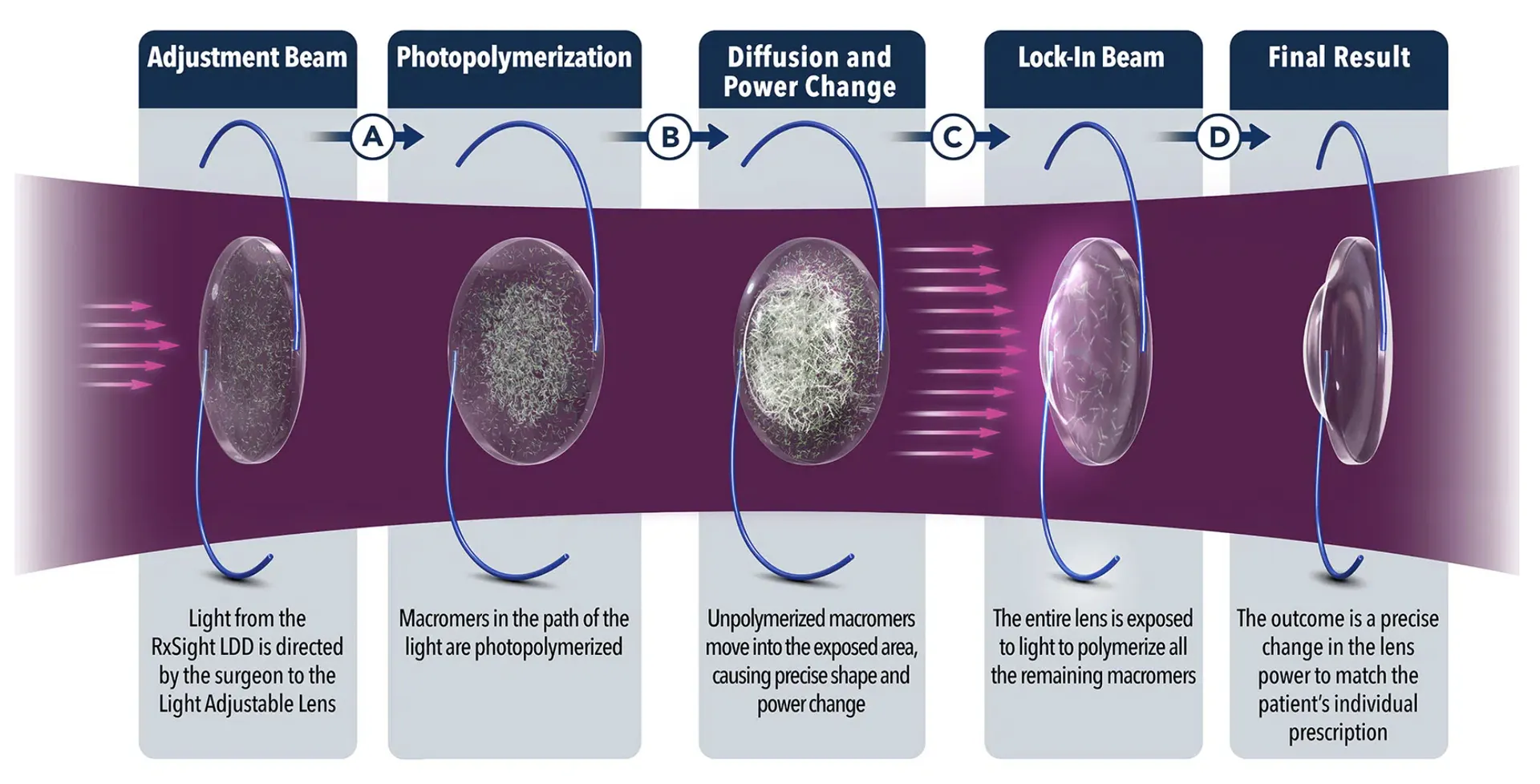
The RxSight Light Delivery Device directs calibrated light to reshape the lens, then a final lock-in beam permanently sets your prescription.
Is LAL Right for You?
Who Benefits Most from the Light Adjustable Lens?
Prior LASIK or PRK Patients
IOL power calculations are inherently less predictable after corneal refractive surgery. The LAL eliminates this uncertainty by allowing post-surgical fine-tuning.
Patients Seeking Maximum Precision
If you want the most accurate post-surgical refraction currently achievable in any IOL, the LAL delivers unmatched results.
Complex or Unusual Prescriptions
High prescriptions, significant astigmatism, or atypical eye anatomy — the LAL’s adjustability accounts for variables that fixed lenses cannot. It is also a great option for refractive lens exchange patients looking to eliminate their dependence on glasses or contact lenses.
Common Questions
Light Adjustable Lens FAQ
Click any question to reveal the answer.
About the LAL
What makes the Light Adjustable Lens different from other IOLs?
The LAL is the only FDA-approved intraocular lens that can be customized after cataract surgery. All other IOLs — monofocal, toric, multifocal, and Extended Depth of Focus (EDOF) — are permanently set once implanted. The LAL uses a photosensitive silicone material that can be reshaped with non-invasive light treatments after your eye has healed, allowing your surgeon to fine-tune your prescription to your actual healed eye rather than pre-surgical estimates.
How does the LAL compare to multifocal or EDOF lenses?
Multifocal and EDOF lenses provide a fixed range of focus at multiple distances but can introduce halos, glare, or reduced contrast sensitivity. The LAL is a monofocal-based lens optimized for the sharpest possible vision at your target distance, with the unique ability to fine-tune after healing. Some patients choose the LAL specifically to avoid the optical trade-offs of multifocal designs while still achieving exceptional precision.
Can the LAL correct astigmatism?
Yes. The light adjustment treatments can correct residual astigmatism after surgery with a high degree of precision. This is one of the key advantages of the LAL — astigmatism correction is fine-tuned to your actual healed eye rather than relying solely on pre-operative measurements and toric lens alignment.
Is the LAL a good option if I’ve had LASIK or PRK?
It is one of the best options available. LASIK and PRK alter corneal curvature, which makes standard IOL power calculations less predictable. The LAL eliminates this uncertainty because the prescription is finalized after surgery based on your actual visual outcome — not pre-surgical measurements alone. Many surgeons consider the LAL the gold standard for post-refractive-surgery cataract patients.
The Adjustment Process
How many light adjustment treatments will I need?
Most patients require one to three light delivery treatment sessions before the final lock-ins. The exact number depends on how much residual refractive error is present after healing and how precisely you and your surgeon want to dial in the final prescription.
What does a light adjustment session feel like?
Each session is painless and non-invasive. You sit at the Light Delivery Device, look at a fixation target, and the calibrated light reshapes the lens material over approximately 90 seconds to three minutes. There is no anesthesia, no discomfort, and no recovery time. You can resume normal activities immediately afterward.
What is the lock-in treatment?
The lock-in is a final light treatment that permanently polymerizes the lens material, fixing your prescription in place. Once locked in, the lens can no longer be adjusted and behaves like any other permanent IOL. This is performed once you and your surgeon are satisfied with your vision.
How long after surgery do the adjustments begin?
Light adjustments typically begin two to four weeks after surgery, once your eye has healed and your refraction has stabilized. This waiting period is essential — it ensures your surgeon is adjusting to your true post-surgical prescription rather than a measurement that may still be shifting.
Protective Glasses & Lifestyle
Why do I need to wear protective glasses?
The LAL is made of photosensitive material that responds to specific wavelengths of light. Protective glasses shield the lens from uncontrolled light exposure between implantation and lock-in, ensuring that only the calibrated light from your surgeon’s Light Delivery Device reshapes the lens. You must wear them indoors and outdoors during this period.
How long do I wear the protective glasses?
You wear the protective glasses from the day of surgery until your final lock-in treatment is complete — typically three to five weeks total. After lock-in, the lens is permanently set and the glasses are no longer needed.
Can I work, drive, and exercise while wearing the protective glasses?
Yes. The protective glasses are designed for daily life. You can work at a computer, drive (once cleared by your surgeon), exercise, and go outside — all while wearing them. They fit over most prescription glasses if needed. The main requirement is consistency: wear them at all times until lock-in.
What happens if I forget to wear the protective glasses?
Brief, incidental exposure is unlikely to cause significant changes. However, repeated or prolonged unprotected light exposure could alter the lens before lock-in, potentially affecting your final prescription. It is important to wear the glasses consistently as directed. If you have concerns about a specific exposure, contact your surgeon’s office.
Cost & Candidacy
Does the Light Adjustable Lens cost more than other IOLs?
Yes. The LAL is an advanced technology lens with additional costs for the light adjustment and lock-in sessions. The total cost includes the lens, the surgical procedure, and the post-operative light treatments. We provide transparent pricing and financing options at your consultation so you can make an informed decision.
How many office visits are required for the full LAL process?
In addition to your standard post-operative visits, you should expect one to three adjustment sessions plus two lock-in treatments — typically three to five additional visits over the weeks following surgery. Each visit is brief. Patients who choose the LAL should be willing and able to attend these appointments to get the full benefit of the technology.
Is the LAL right for everyone?
The LAL is an excellent choice for patients who value the highest refractive precision — especially those with prior LASIK/PRK, unusual prescriptions, or high visual demands. However, it does require commitment: wearing protective glasses for several weeks and attending multiple adjustment visits. Your surgeon will discuss whether the LAL or another advanced technology lens is the best match for your lifestyle and goals.
Content medically reviewed by the physicians of Soni Vision Institute. Last updated April 2026.
Ready for the Most Precise Vision of Your Life?
Schedule your Light Adjustable Lens consultation with Houston's top-rated surgical team.