

Toric Lens
Clear Vision. Even with Astigmatism.
Toric intraocular lenses correct astigmatism at the time of cataract surgery — delivering sharper, crisper distance vision and reducing your dependence on glasses from day one.
Understanding Toric IOLs
What Is a Toric IOL?
Astigmatism occurs when the cornea is shaped more like a football than a basketball — it curves more steeply along one meridian than the other. This uneven curvature causes light to focus at multiple points instead of a single point on the retina, resulting in blurred or stretched vision at all distances. A standard intraocular lens implanted during cataract surgery has uniform power across its entire surface, so it cannot correct this asymmetry. That means patients with significant astigmatism would still need glasses for clear distance vision after surgery.
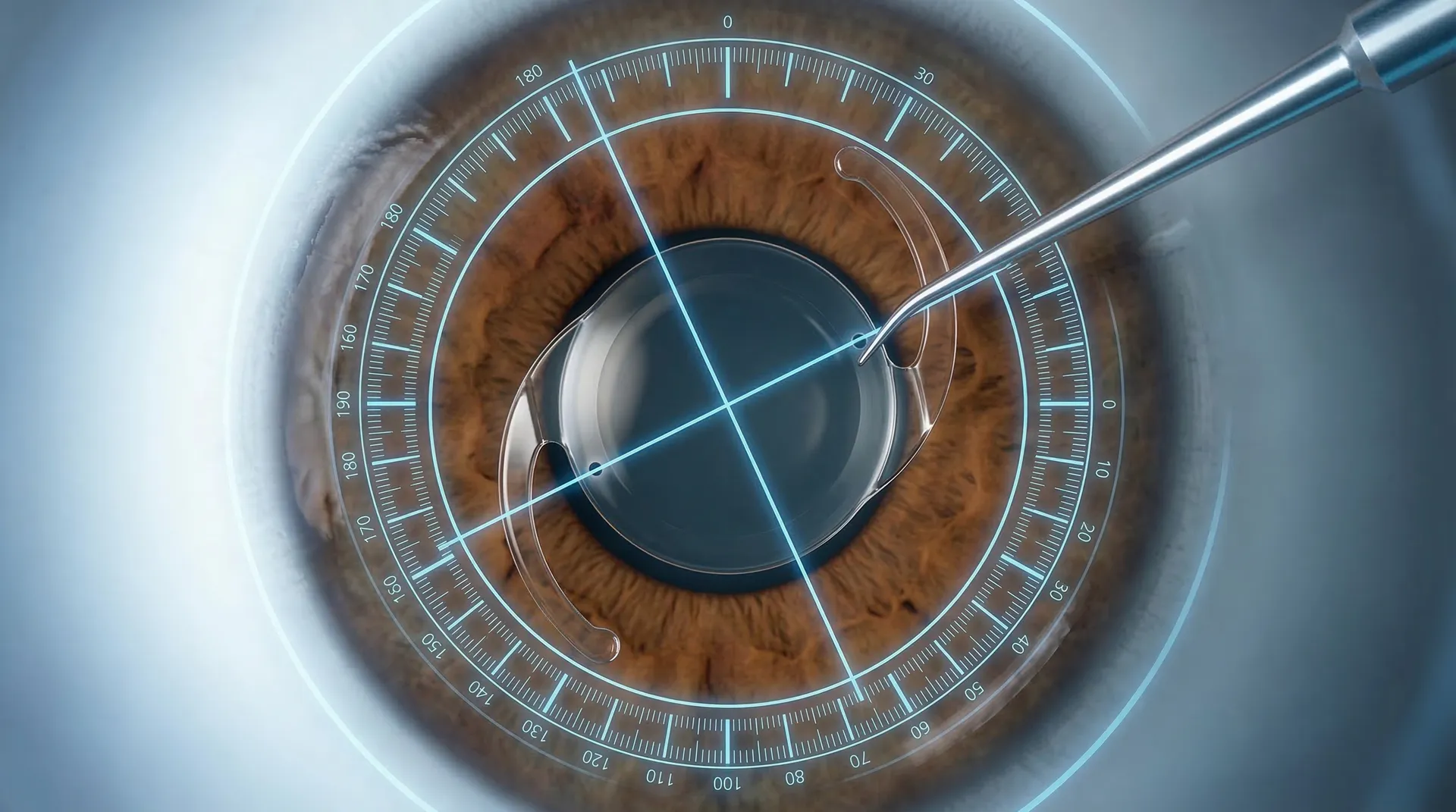
Intraoperative digital guidance aligns the toric lens precisely to the axis of astigmatism for optimal correction.
A toric IOL solves this problem. It is engineered with different optical powers along its two principal axes — essentially building the astigmatism correction directly into the lens implant. During surgery, the toric IOL is precisely aligned to the axis of your astigmatism using intraoperative guidance systems and pre-operative corneal mapping. Once in position, the lens neutralizes the corneal irregularity, allowing light to converge to a single focal point for significantly sharper distance vision without glasses.
Why Patients Choose Toric
Key Benefits
Corrects Astigmatism Simultaneously
Address your cataract and your astigmatism in a single procedure — no separate treatment required.
Reduces Glasses Dependence
Over 90% of toric lens patients achieve sharp distance vision without needing glasses for driving, television, or outdoor activities.
Precise Surgical Alignment
Intraoperative guidance systems and corneal mapping ensure the toric IOL is aligned to your exact axis of astigmatism for optimal correction.
Permanent Correction
Your toric IOL is designed to remain stable and effective for life — a one-time correction with lasting results.
Your Journey
The Process
Pre-Op Corneal Mapping
Advanced topography and keratometry map the precise degree and axis of your astigmatism, ensuring the correct toric lens power is selected.
Precise Toric Alignment
During surgery, your surgeon uses intraoperative guidance to align the toric IOL exactly to your astigmatism axis for maximum correction.
Immediate Visual Improvement
Most patients notice sharper, clearer distance vision within hours of surgery as the toric lens immediately begins correcting astigmatism.
Stable Long-Term Results
Post-operative visits confirm the lens position is stable and your astigmatism correction is holding — delivering lasting clarity for years to come.
Common Questions
Toric Lens FAQ
Understanding Astigmatism & Toric Lenses
What causes astigmatism and how common is it?
Astigmatism is caused by an irregularly shaped cornea — instead of being perfectly round like a basketball, the cornea is curved more steeply along one axis, like a football. This causes light to focus at multiple points on the retina rather than one, producing blurred or stretched vision at all distances. Astigmatism is extremely common; most people have at least a small amount. When it is significant (typically 0.75 diopters or more), it should be corrected during cataract surgery to achieve the sharpest possible vision.
How does a toric lens correct astigmatism differently than glasses?
Glasses and contact lenses sit outside the eye and compensate for astigmatism by bending light before it enters. A toric IOL works from inside the eye, permanently neutralizing the corneal irregularity at its source. Because the correction is built directly into the implant and aligned precisely to your corneal axis, the optical quality is often superior to external corrections — especially in peripheral vision and in situations where glasses might fog, shift, or be inconvenient.
What happens if astigmatism is left uncorrected during cataract surgery?
If a standard (non-toric) lens is implanted in an eye with significant astigmatism, the cataract will be removed and the cloudiness will be gone, but distance vision will still be blurry without glasses. The asymmetric curvature of the cornea will continue to scatter light, leaving you dependent on prescription eyeglasses or contact lenses for clear distance vision. A toric IOL eliminates this issue by correcting the astigmatism at the same time as the cataract is removed.
Toric Lens Alignment & Technology
How does the surgeon ensure the toric lens is aligned correctly?
Alignment is critical for toric lens performance. Before surgery, advanced corneal topography and keratometry map the exact degree and axis of your astigmatism. On the day of surgery, your surgeon uses intraoperative digital guidance systems that project the target alignment axis directly onto the surgical view. The toric IOL is then rotated into precise position and confirmed in real time. This technology-guided approach ensures the lens is aligned within a degree or two of the optimal axis for maximum astigmatism correction.
Can a toric lens rotate or shift after surgery?
Modern toric IOLs are designed with haptic features that grip the lens capsule to prevent rotation. Studies show that current-generation toric lenses maintain their alignment within 5 degrees in over 95% of cases, which is well within the range needed for excellent astigmatism correction. In the rare event that significant rotation occurs, your surgeon can reposition the lens in a brief, minor procedure. Your post-operative visits include checking lens alignment to ensure it remains stable.
Can laser cataract surgery improve toric lens outcomes?
Yes. Femtosecond laser-assisted cataract surgery creates a perfectly sized and centered capsular opening, which can help the toric IOL seat more symmetrically in the eye. The laser can also make precise corneal relaxing incisions to address any residual astigmatism that falls outside the toric lens correction range. When combined, the laser and toric IOL provide a highly accurate, two-pronged approach to astigmatism correction.
Candidacy & Lens Options
How much astigmatism do I need to benefit from a toric lens?
Toric IOLs are generally recommended for patients with 0.75 diopters or more of corneal astigmatism. At this level, leaving astigmatism uncorrected would noticeably blur your distance vision and likely require glasses after surgery. Patients with lower amounts may still benefit depending on their visual expectations and lifestyle. During your consultation, your surgeon will measure your exact astigmatism and discuss whether a toric lens offers meaningful benefit for your specific case.
Can I combine toric correction with a multifocal or Extended Depth of Focus (EDOF) lens?
Yes. Several advanced technology lens platforms are available in toric versions, including multifocal toric and EDOF toric designs. This means you can correct your astigmatism and gain a broader range of glasses-free vision — from distance through intermediate or near — in a single implant. Your surgeon will discuss whether a monofocal toric, multifocal toric, or EDOF toric is the best match for your eyes and visual goals.
What if I have irregular astigmatism — can I still get a toric lens?
Toric IOLs are designed to correct regular corneal astigmatism — the symmetric, predictable type. If your corneal topography reveals significant irregularity (from conditions like keratoconus or prior corneal surgery), a standard toric lens may not fully correct your vision. In these cases, your surgeon may recommend alternative strategies such as a monofocal lens combined with post-operative specialty contact lenses, or in some situations, a Light Adjustable Lens (LAL) that can be fine-tuned after implantation.
Is there an upper limit to how much astigmatism a toric lens can correct?
Current toric IOL platforms can correct up to approximately 4.0 to 6.0 diopters of corneal astigmatism, depending on the specific lens model. For the vast majority of patients, this range covers their full correction. In rare cases of very high astigmatism, your surgeon may combine a toric IOL with supplemental laser corneal incisions to achieve the best possible result. Your pre-operative measurements will determine exactly how much correction is needed and the best strategy to achieve it.
Results & Expectations
How effective are toric lenses at eliminating glasses for distance?
Studies consistently show that modern toric IOLs reduce astigmatism to less than 0.50 diopters in over 90% of patients. At this level, most people experience sharp, functional distance vision without glasses for driving, watching television, outdoor activities, and recognizing faces. Patient satisfaction rates for toric lenses are among the highest of any IOL category, particularly because the improvement over pre-surgical blurry vision is so dramatic and immediate.
Will I still need reading glasses after a toric lens?
A monofocal toric IOL corrects astigmatism and provides excellent distance vision, but it focuses at one distance. Most patients with a monofocal toric will still use reading glasses for close-up tasks like books, phones, and menus. If reducing dependence on reading glasses is also a priority, your surgeon may recommend a multifocal toric or EDOF toric lens, which combines astigmatism correction with an extended range of focus for near and intermediate distances.
What if I still have some residual astigmatism after surgery?
In a small percentage of cases, some residual astigmatism may remain after toric lens implantation. If the amount is visually significant, several options are available. Your surgeon may perform a brief laser enhancement (similar to LASIK) to fine-tune the correction, or in rare cases, the toric lens can be repositioned for better alignment. Most residual astigmatism after a toric IOL is mild enough that it does not affect daily function or require further treatment.
How long do results from a toric lens last?
A toric IOL is a permanent implant designed to last a lifetime. The astigmatism correction it provides does not diminish over time — the lens material remains optically clear and stable for decades. The most common change patients may experience years later is posterior capsule opacification (a slight clouding of the membrane behind the lens), which is easily treated with a quick, painless in-office YAG laser procedure. The toric correction itself remains intact.
Content medically reviewed by the physicians of Soni Vision Institute. Last updated April 2026.
Take the Next Step
Ready to See Clearly Without Astigmatism?
Our highly trained surgeons specialize in precision toric lens implantation. Find out if a toric IOL is the right choice for your eyes.