
Laser Cataract Surgery
Where Technology
Meets Expertise.
Laser-assisted cataract surgery uses femtosecond laser technology to perform key steps of cataract removal with computer-guided precision — offering consistency that cannot be matched by manual technique alone.
Schedule Your Laser EvaluationThe Technology
What Is Laser-Assisted Cataract Surgery?
Traditional cataract surgery relies on the surgeon’s hands to make incisions, open the lens capsule, and break apart the clouded lens. Laser-assisted cataract surgery replaces these manual steps with a femtosecond laser that operates under real-time computer guidance.
Using platforms created by the top ophthalmology industries, the laser performs three critical steps with sub-micron accuracy: creating the corneal incision, executing the capsulotomy (circular opening in the lens capsule), and softening the cataract for gentler removal. The result is a more precise, reproducible procedure with less ultrasonic energy needed inside the eye.
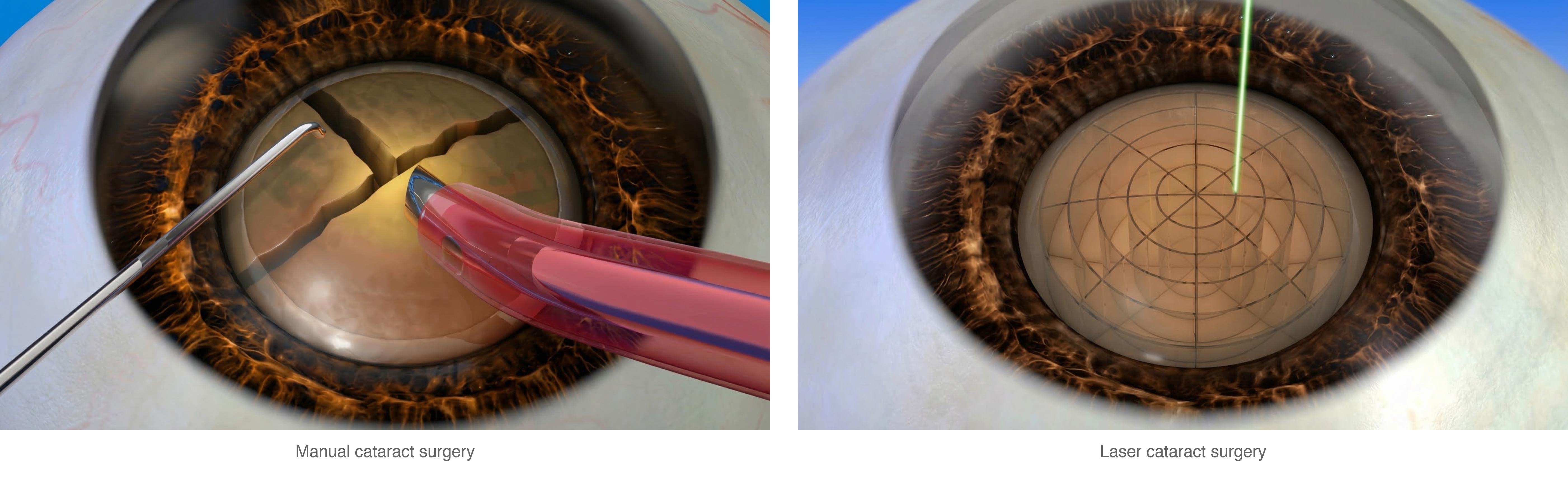
Manual cataract surgery (left) vs. laser-assisted cataract surgery (right)
Precise Circular Capsulotomy
The laser creates a perfectly round, centered opening in the lens capsule — a step that determines IOL positioning and final visual outcome.
Automated Lens Softening
Laser pre-fragmentation of the cataract reduces the amount of ultrasonic phaco energy required, protecting delicate corneal cells.
Bladeless Corneal Incisions
Computer-guided laser incisions are self-sealing and reproducible — no blade required, no variation between cases.
Customized to Your Eye
Advanced 3D imaging maps each eye individually before the laser fires, so every step is calibrated to your unique anatomy.
The Procedure
Your Laser Surgery Step by Step
Pre-Op Laser Mapping
Before surgery, advanced 3D imaging captures precise measurements of your cornea, lens, and anterior segment. This data programs the laser to match your individual eye anatomy exactly.
Laser Procedure
The femtosecond laser step takes under 60 seconds. You will see a light and feel mild suction. The laser silently performs the incision, capsulotomy, and lens fragmentation — all in one automated sequence.
Phacoemulsification & IOL
Your surgeon gently removes the pre-softened lens using ultrasound and implants your chosen intraocular lens through the laser-created incision. The entire surgical procedure typically takes under 20 minutes.
Visual Recovery Begins
Most patients notice meaningfully improved vision within 24–48 hours. Vision continues to sharpen over the following weeks as the eye settles and heals completely.
Why It Matters
Why Laser Precision Matters for Advanced Technology IOLs
Advanced technology intraocular lenses — multifocal, Extended Depth of Focus (EDOF), toric, and the Light Adjustable Lens (LAL) — are precision instruments that demand precise implantation. A perfectly centered capsulotomy and exact incision architecture directly influence how well these lenses perform. Laser-assisted surgery provides the consistency these advanced lenses require for optimal results.
Toric IOL
Designed to correct astigmatism at the time of cataract surgery. Provides sharper, more precise distance vision for astigmatic patients.
Learn More →Extended Depth of Focus (EDOF) Lens
Extended depth-of-focus lenses provide a continuous range of vision from distance through intermediate, with less dependence on glasses for everyday tasks.
Learn More →Multifocal IOL
Corrects vision at multiple distances. Most patients achieve complete independence from glasses and contacts after surgery.
Learn More →Light Adjustable Lens
The only IOL that can be fine-tuned after surgery using light adjustments. Allows your surgeon to customize your vision for a truly personalized result.
Learn More →Common Questions
Laser Cataract Surgery FAQ
Click any question to reveal the answer.
Understanding the Laser
What is femtosecond laser cataract surgery?
Femtosecond laser cataract surgery uses an ultrafast laser to automate several key steps of the procedure — creating the corneal incision, the capsulotomy (opening in the lens capsule), and fragmenting the cataract. This computer-guided approach provides a level of accuracy and consistency that enhances manual surgical technique.
Is laser cataract surgery better than traditional?
Laser-assisted surgery provides a level of precision and reproducibility that manual technique cannot consistently achieve. The laser creates a more perfectly centered capsulotomy, which improves IOL positioning and final visual outcomes — particularly important with advanced technology lenses. It also reduces the amount of ultrasonic energy used inside the eye. For patients choosing advanced technology IOLs, we routinely recommend laser assistance to maximize the result.
Does the laser replace the surgeon?
No. The laser assists the surgeon by automating specific steps with computer-guided precision. Your surgeon is present throughout the entire procedure, makes all clinical decisions, and performs the lens implantation. The laser is a tool that enhances your surgeon’s expertise.
How does the laser map my eye before surgery?
The femtosecond laser uses optical coherence tomography (OCT) to create a detailed 3D image of your eye in real time. This map identifies the exact location, depth, and density of your cataract, the curvature of your cornea, and the position of other structures — allowing the laser to be programmed with sub-millimeter accuracy for your unique anatomy.
Is laser cataract surgery FDA-approved?
Yes. Femtosecond laser platforms used in cataract surgery are FDA-cleared and have been used in millions of procedures worldwide. The technology has a well-established safety record and continues to be refined with each generation of laser systems.
Candidacy & Cost
Who is a good candidate for laser cataract surgery?
Most patients who need cataract surgery are candidates for the laser-assisted approach. It is especially beneficial for patients choosing advanced technology lenses, those with astigmatism, and patients who want the highest level of precision available. Your surgeon will confirm candidacy at your consultation.
Does laser cataract surgery cost more than traditional?
Yes. Laser-assisted surgery involves an additional out-of-pocket fee beyond what Medicare or insurance covers for standard cataract surgery. The exact amount varies based on your procedure and IOL choice. Our team will give you clear, transparent pricing at your consultation — no surprises.
Is the laser portion covered by insurance?
Medicare and most insurance plans cover the basic cataract surgery procedure. However, the laser component and advanced technology lens upgrades are considered elective enhancements and involve an additional out-of-pocket cost. We provide detailed pricing and financing options at your consultation so you can make an informed decision.
Can I choose laser for one eye and traditional for the other?
Technically yes, though most patients who choose laser assistance prefer it for both eyes to maintain consistency in precision and outcomes. Your surgeon can discuss whether a mixed approach makes sense for your specific situation at your consultation.
Laser Precision & Lenses
Why does laser precision matter for advanced technology lenses?
Advanced technology lenses — including toric, extended depth of focus, multifocal, and Light Adjustable Lenses — require extremely precise positioning inside the eye to deliver their full benefit. The laser creates a perfectly centered and sized capsulotomy, which helps ensure optimal lens alignment and the best possible visual outcome.
What is a capsulotomy and why does laser precision matter?
A capsulotomy is the circular opening your surgeon creates in the lens capsule to access and remove the cataract. The laser creates a capsulotomy that is more perfectly circular, centered, and consistently sized than what can be achieved by hand. This precision directly affects how well your new lens implant sits inside the eye — and ultimately how well you see.
Can laser cataract surgery correct astigmatism?
Yes. The femtosecond laser can create precise arcuate incisions in the cornea to reduce astigmatism during cataract surgery. When combined with a toric IOL, this provides the most comprehensive astigmatism correction available — often eliminating or greatly reducing dependence on glasses for distance vision.
How does the laser reduce ultrasound energy inside the eye?
The femtosecond laser pre-fragments the cataract into small pieces before the surgeon begins the removal phase. This means significantly less ultrasound (phacoemulsification) energy is needed to break up and aspirate the lens. Less energy inside the eye can mean less corneal swelling, less inflammation, and a gentler overall procedure.
Safety & Outcomes
What are the risks specific to laser cataract surgery?
Laser cataract surgery carries the same low risk profile as traditional cataract surgery — it is one of the safest procedures in all of medicine. Serious complications are rare. The laser’s computer-guided precision may actually reduce certain risks by creating more accurate and consistent incisions than manual technique alone.
Does laser assistance improve visual outcomes?
The laser’s greatest impact is on precision — creating a more perfectly centered capsulotomy, more accurate incisions, and reducing ultrasound energy. This difference is especially notable with advanced technology lenses, where precise lens positioning is critical to achieving the full visual benefit of the implant.
Does laser cataract surgery mean faster healing?
Because the laser uses less ultrasonic energy inside the eye, some patients experience less corneal swelling and inflammation in the early days after surgery. Most patients notice meaningful vision improvement within the first 1–2 days.
How do I decide between laser and traditional cataract surgery?
The decision depends on your lens implant choice, your visual goals, and your budget. If you are choosing an advanced technology lens or want the highest level of surgical precision, laser assistance is recommended. Your surgeon will help you weigh the benefits at your consultation.
Content medically reviewed by the physicians of Soni Vision Institute. Last updated April 2026.
Ready for Laser-Precision Surgery?
Schedule your laser cataract evaluation with Houston’s top-rated surgical team.