
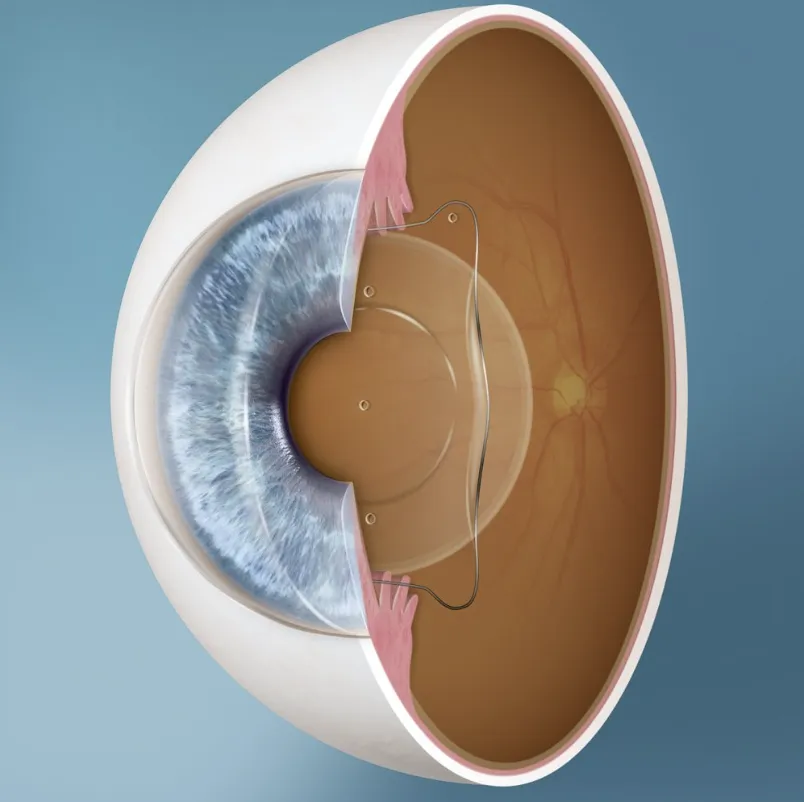
EVO ICL
Crystal-Clear Vision. Without Changing Your Cornea.
EVO ICL is an additive lens implanted inside the eye — not on it. No corneal tissue is removed, the procedure is reversible, and it delivers exceptional clarity for moderate to high prescriptions.
Understanding the Procedure
What Is EVO ICL?
The EVO Implantable Collamer Lens is a soft, biocompatible lens placed behind the iris and in front of your natural lens. Unlike contact lenses that sit on the surface of the eye, the EVO ICL is positioned inside the eye where it works in harmony with your natural anatomy to correct nearsightedness (myopia) and astigmatism.
The lens is made from Collamer — a proprietary material derived from collagen that is naturally compatible with your body's chemistry. Because Collamer contains a UV-blocking chromophore, the EVO ICL filters harmful ultraviolet rays while allowing beneficial visible light to pass through for natural color perception and sharp vision.
One of the most important distinctions of this procedure is that it is entirely additive — no corneal tissue is removed, reshaped, or permanently altered. This makes the EVO ICL fully reversible. If your vision needs change in the future, or if a different solution becomes available, the lens can be removed or exchanged.
Comparison
EVO ICL vs. LASIK
EVO ICL
- No corneal tissue removed — the cornea is untouched
- Corrects −3.0 to −20.0 diopters of myopia
- Fully reversible — lens can be removed or exchanged
- No increased risk of dry eye after surgery
- Built-in UV protection (blocks UVA and UVB rays)
- Ideal for thin corneas that disqualify LASIK
LASIK
- — Reshapes corneal tissue with an excimer laser
- — Best for mild to moderate prescriptions (up to ~−8.0D)
- — Permanent corneal change — not reversible
- — May cause temporary or chronic dry eye in some patients
- — No built-in UV protection
- — Requires adequate corneal thickness for safe treatment
The Procedure
The EVO ICL Procedure
Consultation & Measurements
Your surgeon performs a comprehensive eye examination including corneal topography, anterior chamber depth measurements, and endothelial cell counts to determine your candidacy and select the precise lens size for your anatomy.
Day of Surgery
The procedure takes approximately 15 minutes per eye. After topical numbing drops are applied, a micro-incision (less than 3mm) is made. The EVO ICL is gently inserted through the incision and positioned behind the iris. No sutures are needed.
Rapid Recovery
Most patients notice a dramatic improvement in vision within hours of the procedure. Because no corneal tissue is removed and the incision is self-sealing, healing is rapid. Many patients return to work and normal activities within a day or two.
Follow-Up Care
You will be seen the day after surgery, then at one week, one month, and periodically thereafter. Your surgeon monitors lens positioning, intraocular pressure, and visual acuity to ensure long-term stability and optimal results.
Who It's For
Ideal Candidates for EVO ICL
High Myopia
EVO ICL is FDA-approved for myopia ranging from −3.0 to −20.0 diopters — well beyond the safe treatment range of LASIK. If your prescription is too strong for laser vision correction, ICL may be your best path to glasses-free living.
Thin Corneas
Because EVO ICL does not reshape or remove any corneal tissue, corneal thickness is not a limiting factor. Patients who have been told their corneas are too thin for LASIK or PRK are often excellent candidates for the implantable lens.
Dry Eye Patients
Laser vision correction can worsen pre-existing dry eye by disrupting corneal nerves. EVO ICL avoids this issue entirely. The corneal nerve bed is undisturbed, so patients with dry eye syndrome are not at increased risk of worsening symptoms after surgery.
Active Lifestyles
Athletes, military service members, first responders, and anyone in physically demanding environments benefit from a procedure that leaves no flap and requires no corneal healing. The lens sits securely inside the eye and cannot be dislodged by contact or impact.
Your Questions Answered
EVO ICL FAQ
Understanding EVO ICL
What is the EVO ICL and how is it different from contact lenses?
The EVO ICL (Implantable Collamer Lens) is a thin, biocompatible lens that is surgically placed inside the eye behind the iris, rather than sitting on the surface like a contact lens. Unlike contacts, the EVO ICL does not need to be removed, cleaned, or replaced daily. It provides permanent vision correction while remaining invisible and maintenance-free.
What is Collamer and why is it used in the EVO ICL?
Collamer is a proprietary material made from a collagen co-polymer that is naturally biocompatible with the body's chemistry. It was specifically engineered for use inside the eye because it does not trigger an inflammatory response and allows nutrients to flow freely. Collamer also contains a UV-blocking chromophore that filters harmful ultraviolet rays while preserving natural color perception.
Can I feel the EVO ICL inside my eye?
No. The EVO ICL is extremely thin and soft, and it is positioned behind the iris where there are no nerve endings that detect touch. Patients cannot feel the lens once it is in place, and most forget it is there entirely. It does not cause irritation, dryness, or discomfort.
Is the EVO ICL visible to other people?
No. The EVO ICL sits behind the iris (the colored part of the eye), so it is completely invisible to others. No one will be able to tell you have had the procedure by looking at your eyes. Your appearance remains entirely unchanged.
The Procedure
How is the EVO ICL implanted?
After numbing the eye with topical anesthetic drops, your surgeon creates a micro-incision of less than 3mm at the edge of the cornea. The EVO ICL is folded and gently inserted through this incision, then unfolded and positioned behind the iris and in front of your natural lens. The incision is self-sealing and no stitches are required.
How long does EVO ICL surgery take?
The procedure typically takes about 15 minutes per eye. Most patients are in and out of the surgical suite within 30 minutes total. The actual lens insertion takes only a few minutes; the remaining time is spent on preparation and ensuring proper lens positioning.
Is EVO ICL surgery painful?
No. The procedure is performed under topical anesthesia using numbing eye drops, so you will not feel pain during surgery. Some patients report mild pressure or awareness during lens insertion, but the procedure is brief and most patients describe it as surprisingly comfortable.
Is the EVO ICL truly reversible?
Yes. Unlike LASIK or PRK, which permanently reshape the cornea, the EVO ICL can be removed or exchanged at any time. Because no corneal tissue is removed or altered during the procedure, your eye's natural anatomy is preserved. This reversibility is one of the most significant advantages of the EVO ICL over laser-based procedures.
Candidacy & Comparisons
Who is the ideal candidate for EVO ICL?
The ideal EVO ICL candidate is between 21 and 45 years old with a stable prescription and moderate to high myopia (nearsightedness). It is especially well-suited for patients with thin corneas, chronic dry eyes, or prescriptions too strong for LASIK. Adequate anterior chamber depth is required to safely accommodate the lens.
Can I get EVO ICL if I was told I'm not a LASIK candidate?
Yes, in many cases. The most common reasons patients are disqualified from LASIK are thin corneas, high prescriptions, or dry eye syndrome. Because EVO ICL does not touch the cornea, these factors are not disqualifying. Many patients who are told they cannot have LASIK turn out to be excellent EVO ICL candidates.
What prescription range does EVO ICL correct?
The EVO ICL is FDA-approved to correct myopia (nearsightedness) from −3.0 to −20.0 diopters, with or without up to 4.0 diopters of astigmatism. This range far exceeds what LASIK can safely treat, making EVO ICL the preferred option for patients with moderate to high prescriptions.
How does EVO ICL compare to refractive lens exchange?
EVO ICL preserves your natural lens and is designed for younger patients (21–45) with healthy eyes who want to correct nearsightedness. Refractive lens exchange replaces the natural lens entirely and is typically recommended for patients over 45 who may also be developing presbyopia or early cataracts. Your surgeon will recommend the procedure that best fits your age and visual needs.
Results & Long-Term Care
How quickly will I notice results after EVO ICL?
Most patients notice a significant improvement in vision within hours of surgery. Because the EVO ICL does not require corneal healing, visual recovery is much faster than procedures like PRK. Vision typically continues to sharpen over the first few days as the eye settles, with full stabilization within one to two weeks.
How long does the EVO ICL last?
The EVO ICL is designed to remain in your eye indefinitely. The Collamer material is biocompatible, does not degrade over time, and requires no maintenance or replacement. If your prescription changes significantly in the future, the lens can be exchanged for one with an updated power.
Does EVO ICL affect cataract surgery later in life?
No. If you develop cataracts later in life, the EVO ICL can be removed at the time of cataract surgery without any additional complexity. Because the procedure does not alter the cornea or the natural lens, it does not interfere with future cataract treatment. Your surgeon will have full flexibility to choose the best advanced technology lens for your cataract procedure.
Content medically reviewed by the physicians of Soni Vision Institute. Last updated April 2026.